
Nine oil types sit on Indian shelves—none officially ranked
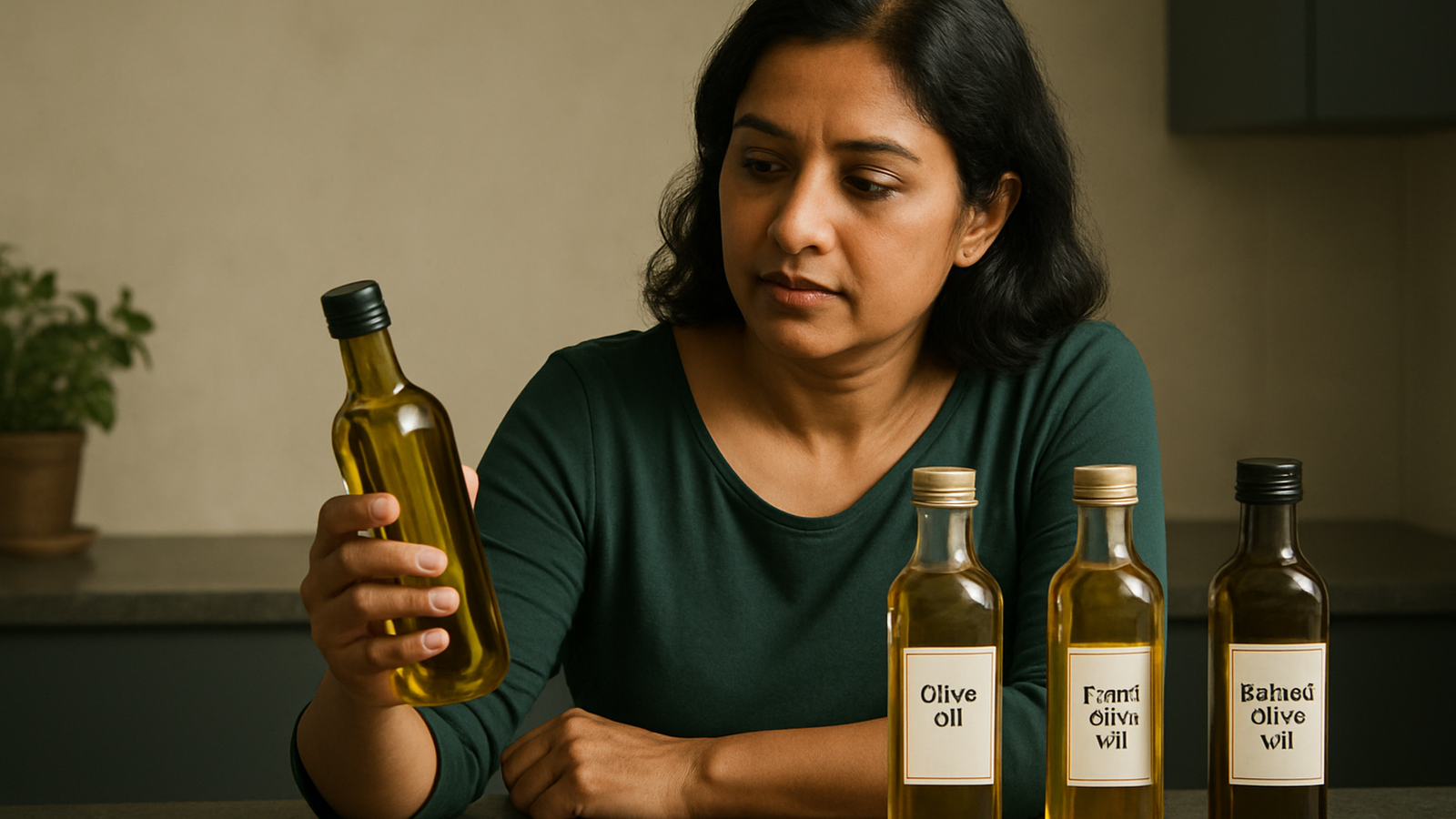
You stand in the aisle facing mustard, groundnut, sunflower, rice bran, coconut, palm, sesame, safflower, olive, and half a dozen blends. The bottles promise heart health, purity, and tradition. You want someone to tell you which is healthiest.
No one will. In India, the Food Safety and Standards Authority of India sets the standards and labeling regulations that manufacturers must follow. It does not rank oils by health merit. Global health authorities offer broader guidance: the World Health Organization and the American Heart Association encourage the consumption of unsaturated fats while advising the limitation of saturated and trans fats. Public health guidance generally favors liquid plant-based oils over tropical oils and partially hydrogenated fats. But these are principles, not product endorsements.
Your task is not to find a winner. It is to compare two variables—fat profile and smoke point—and match them to your stove, your budget, and your willingness to align with unsaturated-fat guidance.
The nutrition panel shows what the front label hides
Turn the bottle around. FSSAI requires every pack to display total fat, saturated fat, and trans fat per serving. These three numbers tell you more than any wellness claim on the front.
Unsaturated fat is what remains when you subtract saturated fat and trans fat from total fat. If a label lists 14 grams of total fat, 2 grams of saturated fat, and 0 grams of trans fat, the unsaturated content is 12 grams. That ratio—unsaturated to saturated—is the first variable you need.
Front-of-pack language about "heart-friendly" or "cholesterol-free" is marketing. The nutrition panel is regulation. Read it.
Fat composition separates liquid plant oils from tropical types
Common Indian cooking oils fall into two broad groups by fat profile.
High unsaturated: sunflower, safflower, rice bran, mustard, groundnut, and sesame. These oils deliver more unsaturated fat than saturated fat. Public health guidance favors this profile.
High saturated: coconut and palm. These tropical oils carry more saturated fat than unsaturated fat. This does not make them toxic or unsafe. It means they sit outside the unsaturated-first framework that WHO and the American Heart Association recommend.
Blends depend on their mix. A sunflower-palm blend will land somewhere between the two parent oils. Check the nutrition panel; the blend's name tells you nothing about its fat breakdown.
Olive oil is mostly unsaturated and widely used elsewhere, but it is less common in Indian kitchens due to cost and a lower smoke point that limits high-heat cooking.
Smoke point decides whether your oil survives the stove
Fat profile alone does not determine whether an oil suits your cooking. Smoke point—the temperature at which oil breaks down and begins to smoke—is the second variable.
High-heat methods such as deep frying and tadka need oils with high smoke points. Refined oils generally tolerate more heat than cold-pressed versions because refining removes particles that burn easily.
Approximate smoke points for refined oils: groundnut around 230°C, rice bran around 230°C, mustard around 250°C, sunflower around 230°C. Coconut oil smokes around 175°C. Extra virgin olive oil typically smokes between 160°C and 190°C.
You will rarely find smoke point printed on the label. Some brands publish it on their websites. Otherwise, you may need to consult reference tables or choose refined oils when high heat is routine in your kitchen.
What this evidence does not tell you—and what you must decide
No market-specific data exist on health outcomes from choosing one Indian cooking oil over another. No single oil has been proven to prevent disease. No oil is healthiest for all uses.
Tropical oils have not been proven harmful in moderation. Seed oils—mustard, sunflower, safflower—have not been proven harmful, despite fringe claims to the contrary. Both statements align with WHO and American Heart Association guidance.
What you decide depends on your cooking method, your budget, your taste preference, and whether you want to prioritize unsaturated fats. The evidence gives you a framework. It does not make the choice for you.
If you're buying cooking oil this week
Turn the pack over. Find total fat, saturated fat, and trans fat on the nutrition panel. Calculate or estimate unsaturated content by subtracting saturated and trans from total.
Match smoke point to your most common cooking method. If the smoke point is not listed and you fry or temper spices often, choose a refined oil with a known high tolerance—groundnut, rice bran, or refined mustard.
Ignore front-of-pack health promises. Prioritize the numbers on the back.
If two oils show similar fat profiles and smoke points, cost and taste may be your tiebreakers.
Common Indian cooking oils: fat profile and smoke point
| Oil type | Unsaturated fat (approx %) | Saturated fat (approx %) | Smoke point (refined) | Typical use |
|---|---|---|---|---|
| Mustard | ~75 | ~10 | ~250°C | Tadka, frying, pickles |
| Groundnut | ~80 | ~17 | ~230°C | Deep frying, all-purpose |
| Sunflower | ~85 | ~11 | ~230°C | Sautéing, frying |
| Rice bran | ~80 | ~20 | ~230°C | High-heat frying |
| Safflower | ~90 | ~8 | ~230°C | Sautéing, light frying |
| Sesame | ~82 | ~14 | ~210°C | Tadka, finishing |
| Coconut | ~10 | ~87 | ~175°C | Low-heat sautéing, baking |
| Palm | ~50 | ~49 | ~230°C | Blends, processed foods |
| Olive (extra virgin) | ~85 | ~14 | ~160–190°C | Salads, low-heat cooking |
| Blends | Varies by mix | Varies by mix | Varies | Check label |
You now have two variables and a shelf full of bottles. No regulator will choose for you. The nutrition panel and your stove will.
How much saturated fat is in one tablespoon of common cooking oils?
Comparison basis: 1 tablespoon (approx 14 g)
| Oil type | Saturated fat per tbsp | Unsaturated fat per tbsp | Fits unsaturated-first guidance? |
|---|---|---|---|
| Safflower | ~1 g | ~13 g | Yes |
| Sunflower | ~1.5 g | ~12.5 g | Yes |
| Mustard | ~1.5 g | ~12.5 g | Yes |
| Groundnut | ~2.5 g | ~11.5 g | Yes |
| Rice bran | ~3 g | ~11 g | Yes |
| Sesame | ~2 g | ~12 g | Yes |
| Coconut | ~12 g | ~2 g | No |
| Palm | ~7 g | ~7 g | No |
Values are approximate and vary by brand, refining method, and source. WHO and American Heart Association guidance favors oils higher in unsaturated fats.










Comments
No login needed. Keep it kind — abusive language is filtered.